.webp)
SUMMARY
European gasoil extended its rally for a second straight month, with ULSD 10ppm NWE CIF averaging $1,283/MT (+9.8% MoM, +88.5% YoY) as Russia's diesel export ban, extended on 30 July through January 2027, kept roughly 11% of global diesel supply off the market. ULSD outperformed the heating-grade Gasoil 0.1% pool, with the inter-grade CIF spread widening from $49/MT to $66/MT as road-fuel demand absorbed the brunt of the shortfall. The clearest single signal of the month was the NWE-MED ULSD spread: it deepened to a cycle low of -$85.50/MT on 14 Aug before flipping to +$9.75/MT by 28 Aug, confirmed independently by the MED CIF assessed-vs-implied index cooling from +$66.88/MT to -$11.06/MT over the same window, as record US and first-in-seven-years Mexican cargoes rebalanced the basin. The forward curve steepened in genuine bull-steepening fashion on the underlying LSGO contract (M1-M12 widened $44.25/MT to $402.75/MT), though the front-end M1-M2 move partly reflects a roll-calendar artifact rather than a clean prompt action, per the expiry-weighted series. Volatility told the other half of the story: coefficient of variation compressed to 4-5% across grades in August from 11-12% in July, meaning the market consolidated at elevated levels rather than continuing to spike. The setup into September rests on the Russian export ban's partial producer exemption effective 1 Sep and whether the Rhine-constrained inland barge market eases in step with the seaborne rebalancing.
MARKET ACTIVITY
Physical – Cargoes
- NWE and MED CIF activity concentrated into fewer, larger positions this month.
- ULSD NWE CIF: trade count and volume both roughly tripled in lockstep (3 to 9 trades; 81,000 to 239,000 MT), average clip size flat at approximately 27,000 MT per trade. Bid/offer eased from 1.82:1 to 1.30:1, less frenzied buy-side pressure than July. Vitol (buyer, 3 trades) and BP (seller, 3 trades) led August; July was too thin to rank.
- ULSD MED CIF: bid/offer stayed extremely skewed both months (25.0:1 July, 10.9:1 August), heavy buy pressure against very few offers. Aramco Trading took 2 of the 5 August buy-side trades, consistent with the unusual-producer-buying signal flagged on the wider CIF data.
- Gasoil 0.1% cargoes (NWE and MED) stayed effectively untraded: zero executed NWE CIF trades in both months (bid-side order-book interest only), and just one MED CIF trade of 25,000 MT in each month, too thin to rank.
Physical – Barges
- ULSD remained the liquidity core of the whole complex; Gasoil grades stayed thin or dead.
- ULSD barges: trade count rose 141 to 168 (+19%), volume rose 369 to 450 KT in step, average lot size ticking up slightly (2.62 to 2.68 KT/trade). Concluded volume sizes increased month-on-month despite Rhine water levels falling, which would theoretically encourage lighter loads; this suggests either that the barges trading here avoid the Rhine corridor entirely, or that they were not materially hampered by the lower water. No third-party flow data confirms either read, so this stays a flag rather than a conclusion. Bid/offer normalized from offer-heavy (0.76:1) toward balance (1.06:1); Shell was the dominant seller in both months (68 then 79 trades), Vitol led buying in August (62 trades, up from 33 in July) as Trafigura eased back.
- Gasoil 50ppm barges held a stable, thin 11 trades in each month, average lot size also flat to slightly up (2.91 to 3.00 KT/trade), the same pattern at smaller scale; persistently offer-dominated (0.09:1 July, 0.21:1 August), Vitol the consistent buyer and Shell/TOTSA the consistent sellers, too concentrated for a genuine top-5.
- Gasoil 0.1% barges saw zero executed trades in either month.
Derivatives
- Activity roughly halved across both active legs; three legs remain structurally illiquid.
- ULSD CIF NWE vs LSGO: trade count nearly halved (59 to 30) and volume halved (300 to 150 MT); TOTSA was the dominant July seller (31 of 59 trades) but eased back in August as Aramco Trading stepped in as a genuine two-sided participant (6 sells, 1 buy), consistent with a producer-trader hedging a physical position it was simultaneously building on the CIF cargo side.
- ULSD CIF MED vs LSGO: the most active derivatives leg overall, though it also nearly halved (78 to 38 trades, 390 to 190 MT); TOTSA remained the dominant seller in both months at an almost identical count (17 both months), while Aramco Trading buy-side footprint more than doubled (5 to 11 trades), reinforcing the same hedging read as the NWE leg.
- ULSD FOB ARA Barges vs LSGO, Gasoil 0.1% CIF NWE vs LSGO, and Gasoil 0.1% FOB Barges vs LSGO all recorded zero executed trades in both months despite live order-book interest; an "exists but does not clear" market rather than a monthly anomaly.
- Gasoil 0.1% CIF MED vs LSGO saw a handful of trades (4 then 5), too thin to rank but worth watching if it builds.
PRICE ACTION
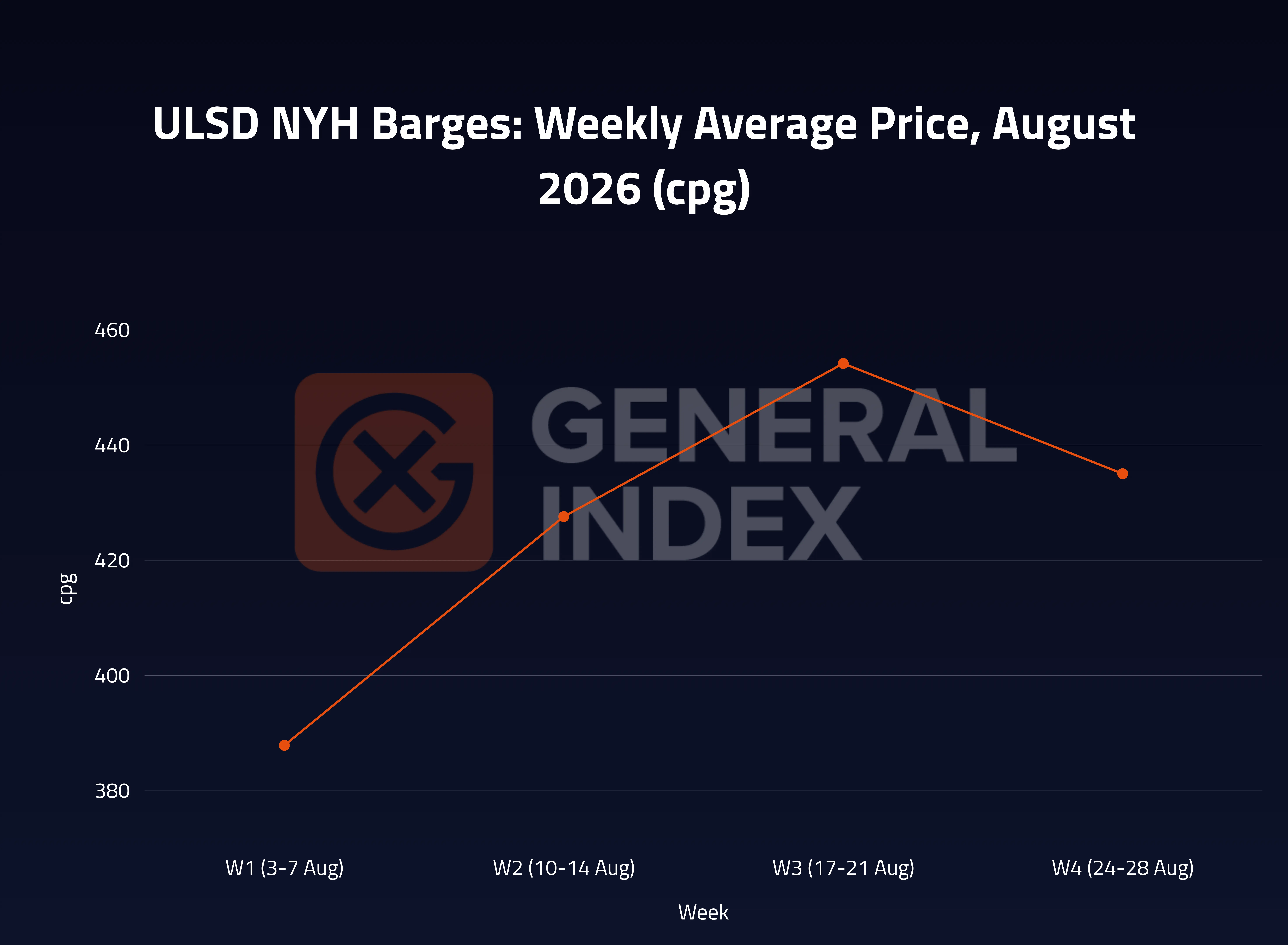
- ULSD 10ppm NWE CIF opened $1,226.50/MT (3 Aug) and closed $1,320.00/MT (28 Aug), averaging $1,283.39/MT vs July's $1,169.00/MT (+9.78% MoM); year-on-year average +88.5% vs August 2025's $680.85/MT.
- Monthly high $1,369.50/MT (21 Aug), low $1,158.00/MT (4 Aug); intra-month range of $211.50/MT, roughly half July's $423.50/MT range.
- Largest single-session move: +$99.25/MT (+8.2%) on 10 Aug, a Friday-to-Monday gap-up from $1,210.75/MT.
- The W4 pullback retraced only a third of the W2-W3 gain rather than fully unwinding it; the market is consolidating at the new range, not fading the rally.
CROSS-MARKET DYNAMICS
- ULSD-Gasoil 0.1% CIF spread averaged $65.85/MT in August vs $48.98/MT in July (+$16.87/MT); peaked at $97.25/MT (19 Aug) before settling $66.75/MT month-end. Road-fuel mandate demand is structurally less price-elastic than discretionary heating-gasoil demand, consistent with ULSD absorbing more of the supply shortfall.
- ULSD CIF-FOB Barges cargo-barge spread averaged $13.27/MT in August vs $11.88/MT in July, distorted by an 11-Aug outlier; excluding it, the average narrows to roughly $10/MT, a genuine tightening of the cargo-domestic gap.
- Gasoil 0.1% CIF-FOB Barges spread was flat on average ($20.73 to $20.98/MT) but widened sharply into month-end, from a mid-month range near $9/MT to $33.00/MT on 27-28 Aug.
- ULSD crack vs Brent averaged +$81.31/bbl in August vs +$74.27/bbl in July (+$7.04/bbl); Gasoil 0.1% crack rose to +$72.96/bbl from +$66.97/bbl (+$5.99/bbl). Both cracks expanded even as Brent itself rallied (+$9.31/bbl average), a distillate-specific tightness signal rather than a broad energy-complex move.
- The ULSD-over-Gasoil crack premium widened from $7.30/bbl (July avg) to $8.35/bbl (August avg), reinforcing the inter-grade CIF spread finding.
CROSS-REGIONAL DYNAMICS
- ULSD NWE-MED spread averaged -$44.55/MT in August (from -$35.46/MT in July, itself already 3x June's -$11.29/MT); hit a cycle low of -$85.50/MT on 14 Aug before a sharp late-month reversal to +$9.75/MT on 28 Aug, the only day in the window NWE priced above MED.
- Independent confirmation: MED CIF assessed-vs-implied (physical vs paper) averaged +$30.22/MT in August, spiking to +$66.88/MT across 13-21 Aug before collapsing to -$11.06/MT by 28 Aug, the same turn visible in the outright spread on the same dates.
- EU-27+UK diesel/gasoil imports rose to 724kbd in August from 466kbd in July (Kpler), more than half from the US, plus Mexico's first ULSD cargoes to Spain in seven years (approximately 300kbd), the physical flow behind the reversal.
- Mid-month MED strength was reinforced by a force-majeure threat at Libya's Zawiya refinery, which pushed replacement sourcing toward Italy, Spain and ARA and widened the MED premium ahead of the import-driven reversal.
- Gasoil 0.1% NWE-MED spread widened less dramatically (-$19.00 June to -$39.55 August), consistent with ULSD carrying the region's tightness disproportionately.
- Caveat: all three Implied Half Daily Structure series (NWE CIF, MED CIF, NWE FOB) stayed in contango throughout July-August, never printing positive; the granular prompt-window paper structure has not caught up to the physical tightness the spread and assessed-vs-implied data show.
CURVE STRUCTURE
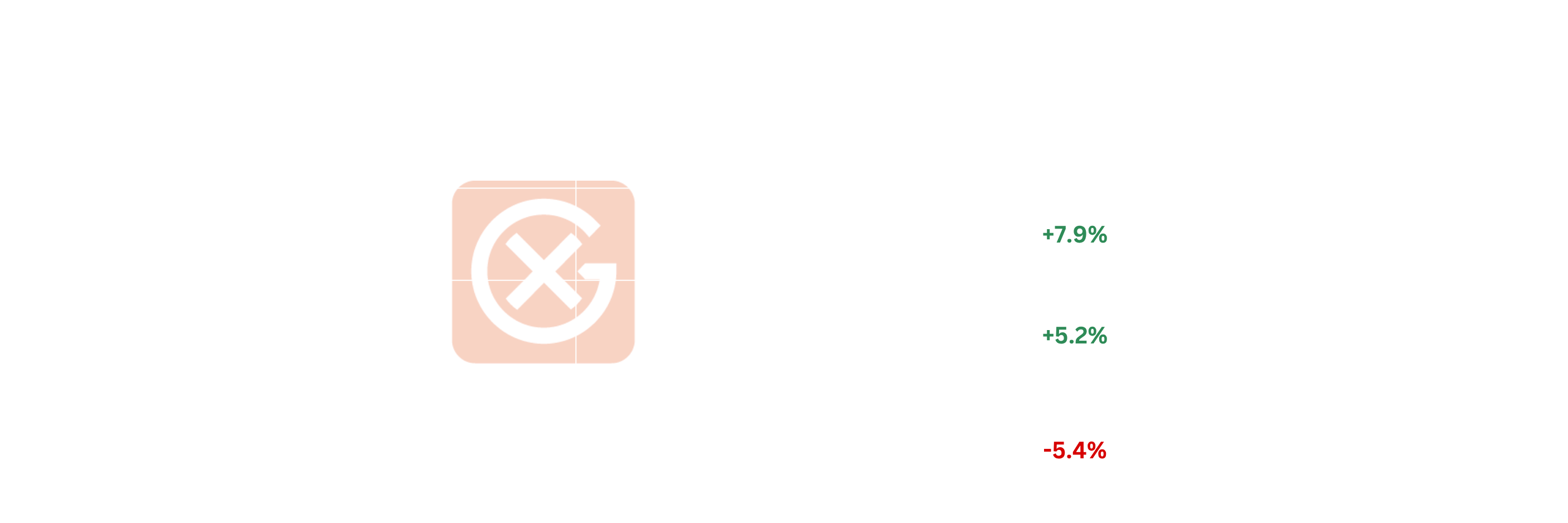
- M1 gained $143.00/MT over August (raw ICE LSGO settlement) vs M12's $98.75/MT, the bull-steepening signature confirmed directly on the underlying paper contract.
- The listing-date-weighted series (expiry-calendar adjusted) tells a different front-end story over the same window: M1-M2 narrowed from +$55.40/MT to +$37.67/MT (-$17.73), even as M1-M12 still widened (+$20.44, to +$348.85/MT).
- The back-of-curve steepening (M1-M12) is robust, confirmed on both the raw and roll-adjusted series; the front-end M1-M2 widening on the raw contract is at least partly a listing/roll artifact and should not be read as a standalone prompt-squeeze signal until confirmed on a subsequent, non-roll-affected session.
- Pattern-shift trigger: the 1 September partial producer export exemption is the near-term test; a genuine resumption of Russian volumes would most likely compress the back of the curve first, since that is where the structural premium currently sits.
PRICE VOLATILITY
- August CV was the lowest of the six-month window for both grades, below even the May trough (6.7-6.9%), despite flat price sitting near the cycle high.
- The compression alongside a still-rising average (August above July for both grades) indicates the market found a new, narrower trading range rather than correcting; risk models calibrated to July's 11-12% CV are currently overstating near-term price risk.
SOMETHING TO WATCH
- Russian export ban partial exemption
- Observation: producers receive limited resumption exemptions from 1 Sep even as the full ban runs through 31 Jan 2027.
- Why it matters: any meaningful volume resumption would most likely compress the back of the curve first (M6-M12), given deferred contracts currently carry the larger structural premium.
- What to monitor: EU/UK weekly diesel-gasoil import volumes (Kpler); Baltic and Black Sea loading data for Russian diesel cargoes.
- Rhine water levels and Kaub barge capacity
- Observation: barges were running at 15-20% capacity through August; ARA independent gasoil stocks fell to a 4-year low; concluded barge lot sizes did not shrink month-on-month despite this.
- Why it matters: a sustained inland bottleneck keeps the cargo-barge and inter-grade spreads wide even if seaborne supply continues to ease; whether barges are avoiding the Rhine or simply unaffected remains unconfirmed.
- What to monitor: Kaub gauge level; Insights Global weekly ARA stock report (Thursdays).
- NWE-MED reversal durability
- Observation: the spread flipped to +$9.75/MT on 28 Aug after averaging -$44.55/MT across the month, with MED assessed-vs-implied cooling from +$66.88 to -$11.06 over the same window.
- Why it matters: a sustained reversal would confirm the Libya-driven MED premium has been resolved by the import surge; a snap-back would signal the reversal was a temporary cargo-timing effect rather than structural.
- What to monitor: daily NWE-MED CIF close; EU-27+UK weekly import volumes (Kpler); Zawiya refinery force-majeure status.
Note: All figures, prices and market activity referenced in this report are based on the period covered by this monthly update.
.webp)

.webp)