SUMMARY
Two gasoline series in this pack fell 5% to 6% on the monthly average, and most of both falls comes from a single session in which the assessed grade changed. On 21 August the Gulf Coast grade switched to winter volatility as Colonial's cycle 49 closed, and RBOB Colonial Pasadena gapped 50.73 cents lower that day. On the Gulf Coast grades the switch did not touch, gasoline closed August at its high. RBOB NYH barges rose 15.51% from a 303.17 open to a 350.20 close while averaging 326.53 against July's 328.58. The blending backdrop changed alongside it: EPA signed a national fuel waiver on 20 August that starts the winter transition on 1 September rather than 16 September, so the summer volatility limit came off the pool about two weeks early. The octane components did not follow. Alkylate rose 23.03% open to close and finished within 0.79 cents of its August high, with its premium over RBOB NYH barges closing at 48.00 cents against an August average of 18.98 and a July average of 7.79.
MARKET ACTIVITY
- Gasoline volume rose 4.82%, moving out of the A2 grade and into A3 and A4
- Aggregate gasoline traded volume rose 4.82% to 59,761,000 bbl even though the headline CBOB A2 grade fell 16.3% to 42,660,500. The volume moved within the family: the A3 grade went from 1,750,000 bbl in July to 10,680,000 and A4 from 100,000 to 1,525,000, taking the two from 3.5% of the family to 22.3%. Both first appeared in July, before the specification switch, so this is a grade migration already under way rather than a consequence of it. These are aggregates of the month's trades, not published index volumes.
- Alkylate traded 355,000 bbl against 325,000, and CARBOB 1,675,000 against 825,000. The octane components and the West Coast kept their liquidity while the base grade rotated.
PRICE ACTION
- RBOB NYH rose 15.51% open to close, and the two Gulf series that fell changed specification on 21 August
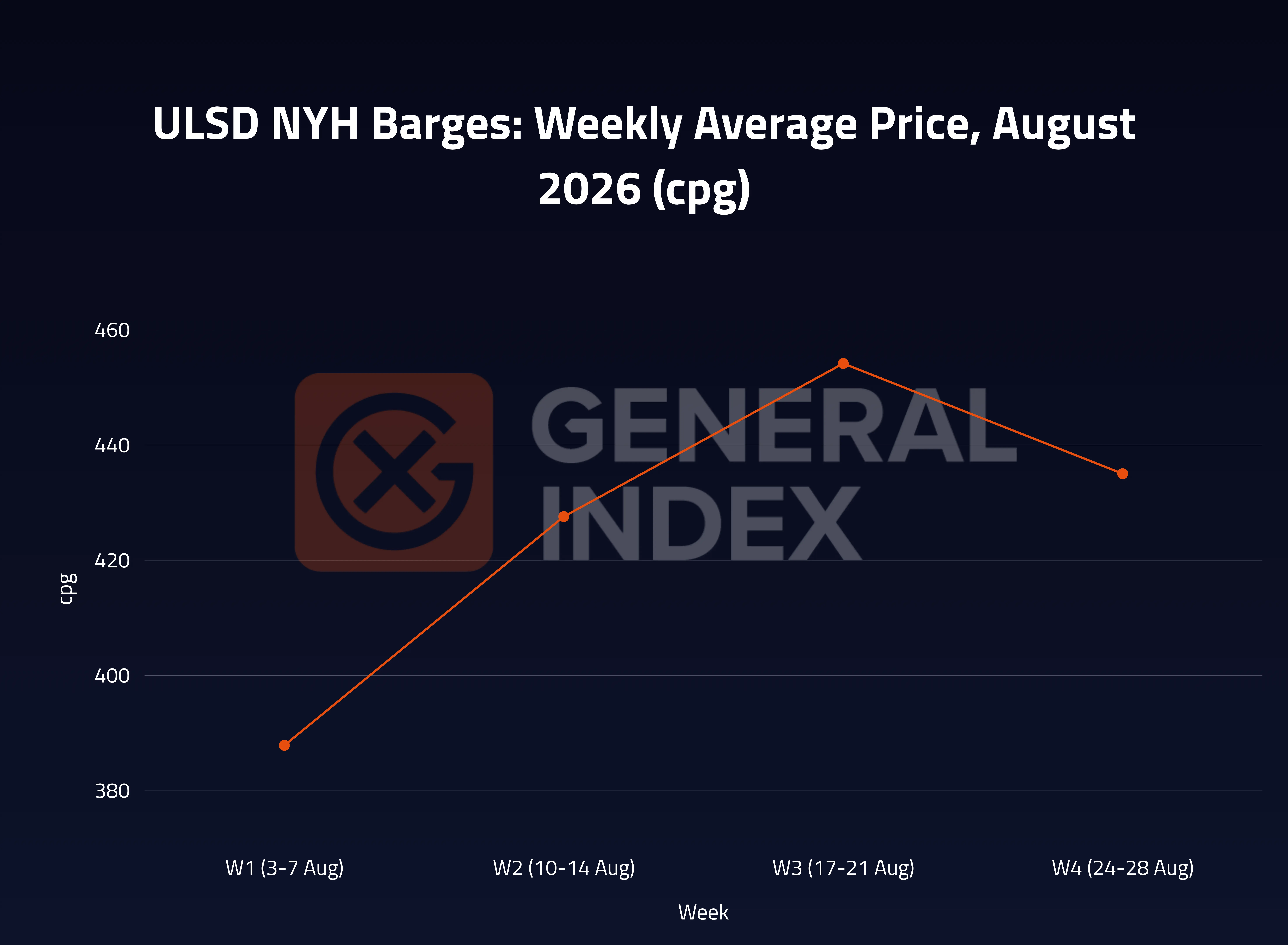
- RBOB NYH barges opened 303.17 cpg, closed 350.20, averaged 326.53 against July's 328.58 (-0.62% MoM, +51.98% YoY against Aug-25's 214.85); high 357.99 (28 Aug), low 291.72 (4 Aug), range 66.27. The average is flat while the path added 15.51%, and the weekly averages rose in each of the four full weeks: 298.53, 321.16, 338.25, 343.46.
- The specification switch accounts for the two largest monthly declines in the pack. The published RVP for RBOB at Colonial Pasadena stepped from 7.40 to 11.50 psi on 21 August and held there for the last seven sessions, when Colonial's cycle 49 closed and the prompt cycle became a winter one. In that session RBOB Colonial Pasadena fell 50.73 cpg and Texas CBOB at Pasadena 41.38 cpg, roughly ten and nine times their own median daily move. The assessed barrel changed, so a position marked against either series moved on the specification rather than on the market.
- The grades the switch did not touch give the like-for-like reading. Colonial Pasadena CBOB A closed at 312.95, Conventional 87 at 335.70 and Premium V at 375.70, and each of those closes is that grade's August high. Over the fourteen summer-specification sessions Pasadena RBOB itself averaged 306.27 cpg against July's 312.92, or -2.12% against the -6.39% the full-month average shows.
- New York Harbor did not switch. Its barge RVP held at 7.40 for RBOB and 7.80 for CBOB on all 21 sessions, because the barge benchmark steps on a fixed calendar date while the Gulf steps with the shipping schedule. That difference carries into September.
- Setting the two switched series aside, every finished gasoline location sits inside a 3.4 point band on the monthly average, from Pasadena CBOB at -1.40% to Group Three at +1.99%, with NYH barges at -0.62% and CARBOB at -0.22% in between. The differences between locations show up in the paths rather than in the averages.
CROSS-MARKET DYNAMICS
- Alkylate closed 48 cents over RBOB while the premium spread at New York narrowed
- Two constraints on the gasoline pool released within nine days. The Gulf grade went to 11.5 psi on 21 August, and EPA's national fuel waiver, signed 20 August and effective from 29 August, moved the winter transition to 1 September from 16 September. The volatility specification is what limits how much cheap light blendstock the pool can carry, so both changes admit more of it.
- The octane components went the other way. Alkylate averaged 345.51 cpg (+2.72% MoM) and rose 23.03% from 323.67 to 398.20, closing within 0.79 cents of its 28 August high of 398.99. Reformate led the blendstocks on the monthly average at +3.88% to 391.89 and rose 18.25% open to close. Premium gasoline on the USGC waterborne closed at its monthly high of 417.95, up 23.68% open to close.
- Alkylate's premium over RBOB NYH barges closed at 48.00 cents against an August average of 18.98 and a July average of 7.79. Cheap light blendstock displaces volume rather than octane, so a pool carrying more of it needs more alkylate and reformate to hold the grade.
- The finished barrel did not price that the same way. Premium RBOB NYH barges over regular averaged 31.13 cpg against July's 31.93 and closed at 26.00 against a 31.00 open, on identical keys. The octane premium widened in the blendstock in the same month it narrowed in the finished grade.
- RIN values fell on the average and round-tripped on the path. The D6 RIN averaged 209.73 cpg against July's 236.81, down 11.44%, but opened 220.00, peaked 221.00 on 19 August, fell 33.20 cents in the single session of 24 August to a 175.00 low on 26 August and recovered to close 216.00. A blend economics mark taken off the August average understates the obligation by the gap between 209.73 and 216.00.
CROSS-REGIONAL DYNAMICS
- Both coasts rose on the path, the interior did not, and the two interior hubs came apart
- On the path both coasts rose and the interior did not. NYH added 15.51% open to close and the Pasadena grades between 9.50% and 11.76%, while Group Three managed 2.58% and Chicago finished 7.11% lower than it started. Chicago is a round trip rather than a decline: it opened 316.17 cpg, lost 27.95 cpg on 4 August to a 277.38 low the next session, recovered to 326.67 on 18 August and closed 293.70.
- The coast-to-Gulf gap widened on the grade that did not switch specification. CBOB at NYH barges averaged 321.21 cpg against CBOB at Colonial Pasadena's 296.91, a 24.30 cent gap against July's 21.16, opening at 13.37 and closing at 24.25 after a 40.63 high on 27 August. The two series carry different keys, so read the level as indicative and the direction as the signal.
- The interior gap kept moving one way. Group Three averaged 313.52 cpg against Chicago's 304.78, a +8.74 cent gap where July's was +1.63 and April's was -21.60. Group Three has gained on Chicago in every month since April and crossed above it in July, so August extends a move rather than starting one.
- Treat the West Coast as one observation. The Los Angeles and San Francisco CARBOB assessments carry the same value in every August column and differ only in the year-ago average, which produces a year-on-year split of 51.24% against 42.87% that is not a real regional difference. CARBOB averaged 348.89 cpg, -0.22% MoM, opening 335.67 and closing 373.70 with a 414.99 high on 28 August. The two Chicago CBOB series are effectively one observation as well.
CURVE STRUCTURE
- The New York strip rose at every tenor, and most at the front
- Between the first and last August session the NYH RBOB forward curve rose at every tenor: M2 by 32.58 cpg, M6 by 20.18 and M12 by 16.36. The rally reached the back of the curve, but it decayed with tenor and the front-to-back spread widened, M2 minus M12 going from 25.92 to 42.14 cpg. The series has no Period 1 value at either date, so no front spread can be computed.
- Direction only. The calendar month behind each period shifts through the month, and summer against winter specification sits inside any gasoline curve, so the level of a gasoline M1-M6 gap is not a curve signal at any time of year and least of all in August.
PRICE VOLATILITY
- Dispersion rose across most of the gasoline pack, led by the West Coast
- CARBOB at 7.90 against July's 5.51 is the noisiest series in the table and its highest reading since March, in a month its monthly average barely moved. The West Coast did its work in the path.
- Pasadena RBOB at 7.69 against 4.56 is the largest increase, and the 21 August specification session sits inside the calculation. As a measure of market dispersion it overstates.
- Alkylate rose to 7.51 from 4.91, so the octane components were not quiet either.
- Five series got calmer and they cluster. The three Colonial Pasadena grades the switch did not touch all fell: CBOB to 3.75 from 4.50, Conventional 87 to 3.82 from 4.61 and Premium V to 4.16 from 4.69, with CBOB the calmest reading anywhere in the pack. The Pasadena grade that did switch went the other way, which is the cleanest evidence that its 7.69 is the specification and not the market. Both Chicago series also fell, to about 4.72 from about 6.27, while Group Three edged up to 5.77 from 5.53, so the interior did not move as one.
SOMETHING TO WATCH
- The New York Harbor specification change on 16 September, which is the Gulf Coast event with a two-week lag:
- Observation: The Gulf grade went to 11.50 psi on 21 August and moved 50.73 cpg in one session, while NYH barge RVP held at 7.40 and 7.80 on all 21 August sessions and steps on a fixed calendar date.
- Why it matters: New York spends the first half of September with the federal volatility limit already waived while the assessed barrel is still summer specification, then takes a discontinuity of the same character as the Gulf's. A month-on-month gasoline comparison across that date can show a decline that is a specification step rather than a price move, as the Gulf's did in August.
- What to monitor: The published NYH barge RVP codes stepping off 7.40 and 7.80; Colonial Pasadena RBOB against NYH barges across the September change.
- Whether the octane bid holds once the volatility limit is fully off:
- Observation: Alkylate closed 48.00 cents over RBOB NYH barges against an August average of 18.98 and a July average of 7.79, while premium RBOB NYH barges over regular closed at 26.00 cents against a 31.00 open.
- Why it matters: Cheap light blendstock displaces volume in the pool rather than octane. The blendstock and the finished barrel priced octane in opposite directions in August, and one of the two adjusts. If the alkylate premium holds, the pool is short octane rather than short barrels, which is a different September blend from the one the flat price implies.
- What to monitor: Alkylate and reformate against RBOB NYH barges; premium RBOB NYH barges over regular on the same key.
- The obligation cost, which fell on the average and not at the close:
- Observation: The D6 RIN averaged 209.73 cpg against July's 236.81, down 11.44%, but fell 33.20 cents in the single session of 24 August to a 175.00 low on 26 August and recovered to close 216.00. The RVO fell 8.11% on the average and closed at 34.06 cpg.
- Why it matters: The obligation is a per-gallon cost on every blended gallon, so where it sits at month end matters more for a September mark than where it averaged. Taken off the August average, that mark is 6.27 cents light before any blending decision is made.
- What to monitor: The D6 RIN daily against its 216.00 close; the RVO, which moved 4.50 cents in the single session of 28 August.
Note: All figures, prices and market activity referenced in this report are based on the period covered by this monthly update.
.webp)

.webp)