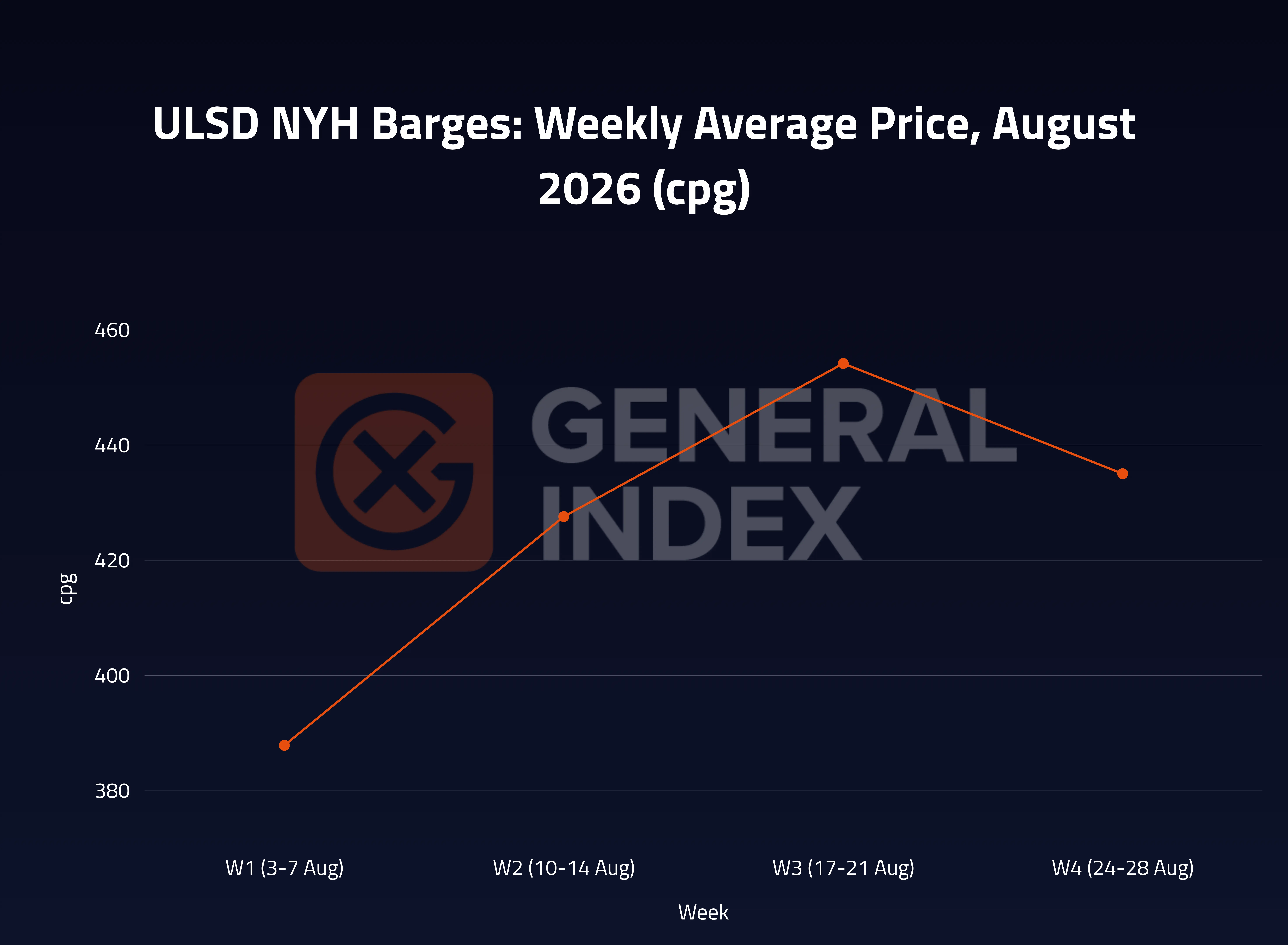
.webp)
SUMMARY: ULSD 10ppm NWE CIF averaged $1,169.00/mt, +18.54% MoM and +58.18% YoY, rising from $943.75/mt (open, 01-Jul) to $1,360.50/mt (close, 31-Jul). Two shocks landed in the same 08-Jul session, the collapse of the three-week US-Iran ceasefire and Russia's full diesel export ban covering producers as well as traders, and ULSD gained $126.00/mt. Gulf risk carried most of that move complex-wide, jet rising $121.00/mt the same session without direct exposure to the ban, while the ban's diesel-specific effect sits in the diffs: the gasoil-ULSD barge diff widened from -$39.76/mt to -$57.83/mt and jet fell behind ULSD to -$6.01/bbl. Russian diesel loadings ran 234,000 b/d over 1 to 10 July against a 2025 average near 817,000 b/d (Kpler), and with June refinery runs 6 mb/d below year-ago and Middle East export refineries still down (IEA), the ULSD crack vs Brent averaged a series-record $73.25/bbl. Escalation continued: Houthi attacks on two Saudi tankers on 22-23 July added a second chokepoint and lifted ULSD $58.75/mt on 23-Jul, reversed almost exactly on the 24-Jul strike pause. The squeeze concentrated in the Mediterranean, Turkish ports going from 7 indications to 112, 110 of them bids, widening the NWE-Med discount from -$8.95/mt to -$35.05/mt. Bull steepening held, M1-M12 widening from +$164.25/mt to +$433.75/mt, and the month's second-largest session came on 29-Jul at +$85.25/mt with the ban four sessions from an undated expiry.
Market Activity
- Physical cargo offers collapsed 59.8% to 39 and bid/offer reached 10.03:1 with only 7 trades cleared all month; the cargo market stopped functioning as two-sided
- Barges absorbed the flow, trades up 53.5% to 152 and conversion from 41.1% to 62.0%; ARA barrels cleared while cargoes did not, consistent with local inventory being drawn rather than replaced by imports
- Derivative diffs took the directional bid, bids up 31.4% to 515 against offers down 7.1%; paper carried the view because physical could not source the barrel
- Cargo bidding migrated south, Med bids up 34.4% to 281 against NWE down 35.8% to 52, taking the Med to 84.4% of physical cargo bids from 72.1%
- Turkish ports took 39.1% of Med cargo bids vs 3.3% in June: 110 bids, 2 trades, zero offers. Consumer Tupras Trading bid 10 times vs 3
- Intermediary Castleton placed 70 of the 110 while offering 12 NWE cargo diffs and 5 CIF Amsterdam, paying up in the premium market and selling the discount one: suggesting obligation-driven cover, not relative value. Absent from Turkish ports in April and May
- Refiner-trader Aramco Trading left the seller top six, fourth on 67 records in June, while third among buyers on 146: the unusual producer-buying signal, pulling offers and staying bid at multi-month highs
Price Action
- ULSD CIF gained 44.16% open to close, $943.75/mt (01-Jul) to $1,360.50/mt (31-Jul), averaging $1,169.00/mt vs June’s $986.20 and July 2025’s $739.01 across 23 assessments; Gasoil 0.1% CIF averaged $1,120.02/mt (+16.55% MoM, +56.04% YoY)
- Largest session was 08-Jul, ULSD +$126.00/mt (+12.83%) and gasoil +$137.75 (+14.40%), the day the ceasefire collapsed and the export ban was announced; jet gained $121.00/mt the same session without direct exposure to the ban, so Gulf risk carried most of it
- Red Sea escalation printed a second distinct spike: ULSD +$58.75/mt (+4.62%) on 23-Jul after the Saudi tanker attacks, reversing -$56.75/mt on 24-Jul as strikes paused; gasoil tracked it at +$54.25 then -$55.75
- The second-largest session was 29-Jul, ULSD +$85.25/mt (+6.73%) and gasoil +$86.00 (+7.17%), four sessions before the undated 31-Jul expiry; jet eased 1.41% on the week, so this leg was diesel-specific rather than complex-wide
- Intra-month range widened to $423.50/mt on ULSD from $257.75 (+64.31%) and to $384.75 on gasoil from $251.00 (+53.29%), 3.01x and 2.72x the widest of the eight months before March 2026, though both stay third widest of the last thirteen
- April, May and June each printed their high in the first three sessions and decayed; July printed its low on 02-Jul and its high on 31-Jul on both grades, so the shock landed inside the month rather than being carried in
ULSD 10ppm NWE CIF Cargoes (USD/mt)
Gasoil 0.1% NWE CIF Cargoes (USD/mt)
CROSS-MARKET DYNAMICS
- ULSD CIF crack vs Brent averaged $73.25/bbl vs $47.97 and Gasoil 0.1% $66.68 vs $44.59, both series-record monthly averages; with June refinery runs 6 mb/d below year-ago and Middle East export refineries still down (IEA), product stayed tight while crude supply recovered, so the tightness is not a crude passthrough
- The gasoil-ULSD barge diff widened from -$39.76/mt to -$57.83 and jet fell behind ULSD from -$1.50/bbl to -$6.01; Russian loadings of 234,000 b/d over 1 to 10 July against a 2025 average near 817,000 b/d (Kpler) is where the ban shows up, in the diffs rather than the flat-price sessions
- Physical repriced above paper with a lag, the ULSD CIF premium to ICE LSGO futures still $10.00/mt on 08-Jul then $26.50 (10-Jul), $30.75 (13-Jul) and $47.75 (14-Jul), averaging $32.98/mt vs $16.09 and peaking $56.50
- That premium strengthened through the escalation, the opposite of jet, where assessed versus implied widened to -$53.71/mt by 30-Jul: gasoil’s rally carried a physical base that jet’s did not
CROSS-REGIONAL DYNAMICS
[Arb economics, freight, regional spreads, import/export flows.]
- ULSD NWE minus Med moved from -$8.95/mt to -$35.05, closing -$56.00, as the Med led Europe higher; gasoil widened from -$18.17 to -$29.06, so the pull was regional rather than grade-specific
- The mechanism is in the cargo book: NWE bids fell 35.8% while Med rose 34.4%, and offers fell 72.5% in the Med and 50.0% in NWE. Turkey, one of the two largest buyers of Russian diesel through June, entered as a price-taker; the discount is what NWE conceded to stop losing cargoes
- Singapore 10ppm minus ULSD NWE averaged -$108.59/mt vs -$38.80, closing -$163.08 and reaching -$207.34 on 08-Jul, a $69.79/mt widening; no series record, the all-time low being -$334.64/mt (08-Mar-2022)
CURVE STRUCTURE
- Bull steepening rather than prompt squeeze: M1 rose $394.00/mt against M12 at +$124.50 with M6 up $203.50, and M1-M2 widened $56.75 against M1-M6 $190.50 and M1-M12 $269.50, the front rallying 3.2x the back and the move graded across tenors rather than confined to the prompt
- Gasoil 0.1% steepened in parallel but less, M1-M12 widening $247.50/mt, keeping the diesel-specific premium embedded in the forward curve
- July’s closing M1-M12 of +$433.75/mt is not a series record; April 2026 reached +$464.75 on 30-Apr, so the curve remains below its Hormuz-peak backwardation despite the flat-price rally
ULSD 10ppm NWE CIF (USD/mt)
Gasoil 0.1% NWE CIF (USD/mt)
PRICE VOLATILITY
- ULSD CIF CV rose from 8.89% in June to 12.14%, second only to March 2026’s 13.77% in the thirteen months pulled; Gasoil 0.1% rose from 9.11% to 11.14%, second to March’s 11.48%
- May’s easing to 6.81% did not hold: three of the last five months sit above 9%, so the elevated regime that began in March is intact rather than decaying
- Hedging books calibrated to February 2026’s 3.94% and 4.60% readings are understating realised volatility by 2.4x to 3.1x; until the export ban resolves, 9% to 12% is the working baseline for position sizing
SOMETHING TO WATCH
- Russian ban status past the 31 July expiry:
- Observation: the ban ran only to 31-Jul, but on 25-Jul the gasoline ban was extended to end-2026 while diesel was left to be lifted as the market recovers, undated; 29-Jul then delivered +$85.25/mt
- Why it matters: the curve closed at +$433.75/mt M1-M12 and both grades closed at monthly highs, so expiry on schedule is not in the price; a confirmed lifting triggers a front-led unwind, a formal extension reprices M6 and beyond
- What to monitor: Russian statements on the diesel measure; weekly Russian diesel loadings against the 234,000 b/d run rate of early July (Kpler)
- Dual-chokepoint risk, Hormuz and the Red Sea:
- Observation: strikes paused 24-Jul and resumed from 28-Jul, with the Red Sea a second front after the 22-23 Jul Saudi tanker attacks and Hormuz transit under 10 commodity vessels a day against roughly 100 pre-war
- Why it matters: with two routes disrupted, de-escalation on one no longer clears the risk premium, and any further Red Sea attack repeats the 23-Jul mechanism directly, worth $55 to $60/mt on the session
- What to monitor: daily Hormuz transit count; Red Sea transit volumes and further attacks on Gulf or Saudi tanker traffic; any US-Iran talks signal
- Physical cargo offer withdrawal as the regional canary:
- Observation: cargo offers fell 59.8% to 39 with bid/offer at 10.03:1, and NWE bids fell 35.8% while Med bids rose 34.4%
- Why it matters: while sellers decline to replace offers the NWE-Med discount widens from its -$56.00/mt close; offers returning is an early sign the region has secured replacement supply
- What to monitor: weekly cargo bid/offer by region; the NWE-Med ULSD spread; whether Turkish bids begin clearing, having managed 2 trades on 110 bids
- Physical premium to LSGO futures as the scarcity gauge:
- Observation: the premium rose from $12.25/mt (01-Jul) to $41.00 (31-Jul), peaking $56.50, averaging $32.98 vs $16.09
- Why it matters: this is physical tightness net of the paper market, so it leads flat price on the way down; compression toward June’s $16/mt average signals cargo availability returning before the crack reflects it
- What to monitor: weekly close on the cargo-to-LSGO basis; the two-to-four session lag between paper and physical seen after 08-Jul
Note: All figures, prices and market activity referenced in this report are based on the period covered by this monthly update.
.webp)

.webp)