Distillate stocks built two weeks running, by 4.6 and then 1.4 million barrels, and the diesel margin expanded anyway. ULSD NYH barges averaged 391.65 cpg against June's 341.54 (+14.67% MoM, +60.6% YoY), and the crack against Dated Brent averaged 80.09 per barrel from 58.03, a 38.01% expansion on top of a June already 157% above the prior year. The coast pulled hardest: the NYH barge diff widened to 2.93 cpg from 1.69 while the Group Three and Chicago diffs deepened to -34.78 and -44.41 cpg. Jet lagged diesel through peak flying season, the jet minus ULSD spread deepening to -43.03 cpg from -32.77. The curve carried the rest: M1-M6 and M1-M12 both roughly doubled while the prompt spread narrowed, a market pricing scarcity out along the strip rather than only at the front.
PRICE ACTION
- Diesel added 14.67% MoM and ran crude two to one, with the whole move front-loaded into weeks two and three.
- ULSD NYH barges opened 323.29 cpg, closed 416.05, averaged 391.65 against June's 341.54 (+14.67% MoM, +60.6% YoY against Jul-25's 243.87); high 443.51 (29 Jul), low 318.72 (2 Jul), range 124.79.
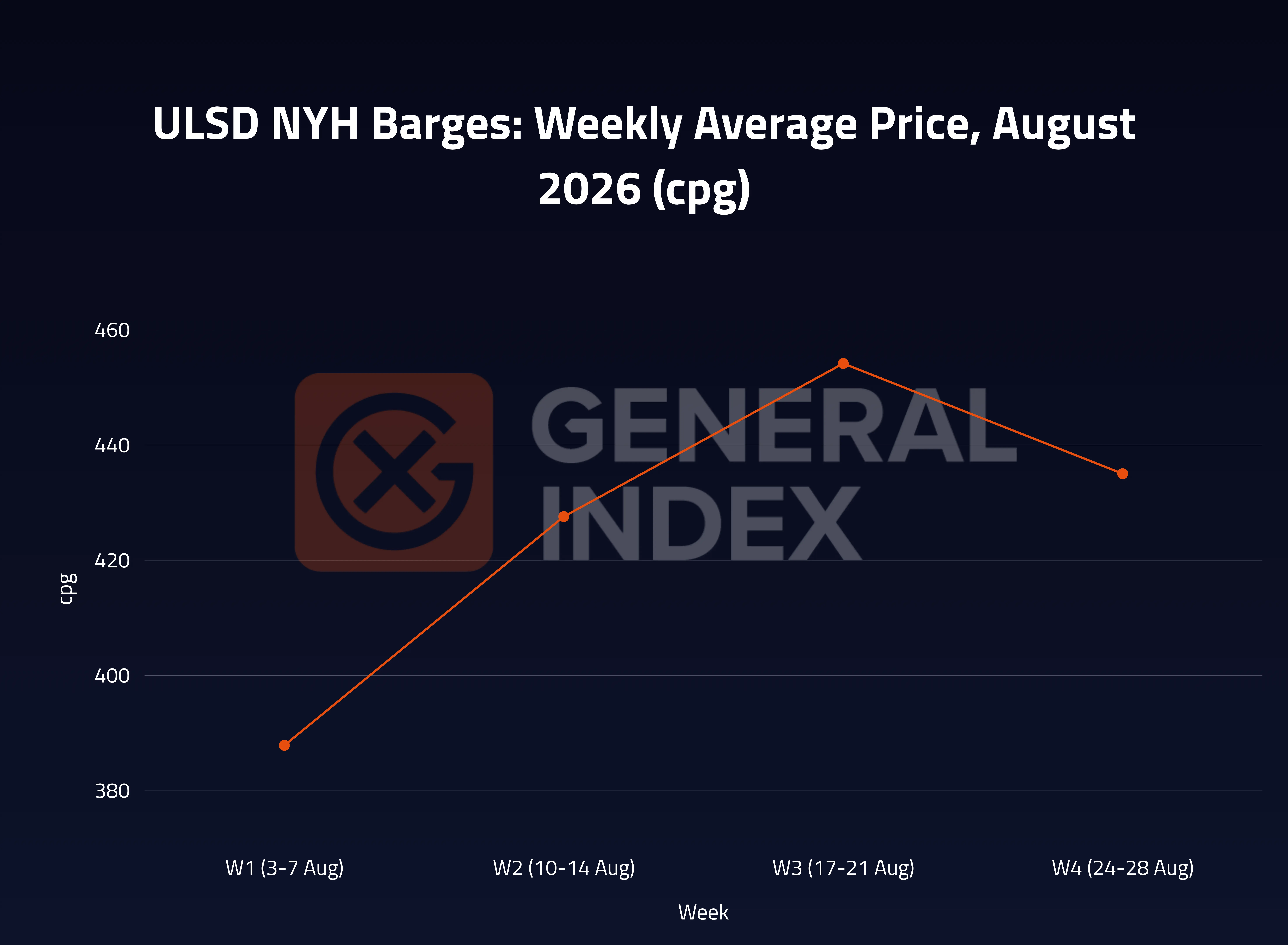
- The weekly walk shows where the month was won: W1 325.26, W2 371.71 (+46.45 WoW), W3 409.78 (+38.08), W4 424.17 (+14.39), W5 429.00 (+4.83). Two weeks carried 84.53 of the 103.74 cpg climb in weekly averages; the last two were consolidation at the highs, not continuation.
- Colonial Pasadena averaged 381.25 cpg (+14.58%) and Group Three 354.06 (+12.61%), while Chicago West Shore lagged at 342.14 (+8.71%), roughly six points of MoM behind the coast.
CROSS-MARKET DYNAMICS
- The crack expanded 38% while inventory was being added, which is not what a demand-led move looks like.
- ULSD NYH against Dated Brent averaged 80.09 per barrel against June's 58.03 (+38.01% MoM, +157.3% YoY); the Pasadena leg averaged 75.72 from 54.34 (+39.36%).
- Distillate stocks rose 4.6 million barrels to 10 July and a further 1.4 million to 17 July, and the crack expanded through both builds. A margin that widens while inventory is being added is not being set by the weekly balance, and the curve section below shows where it is being set instead.
- Jet against Dated Brent expanded faster in percentage terms, 57.65 per barrel from 40.57 (+42.10%), but off a base roughly 22 per barrel under diesel, so jet expanded quickly and stayed the cheaper molecule.
- Group Three ULSD against Domestic Sweet Cushing Cash averaged 69.27 per barrel from 50.14 (+38.14%), confirming the expansion is not a coastal artifact.
CROSS-REGIONAL DYNAMICS
- The coast bid and the interior did not, widening basis in both directions from the screen.
- The NYH barge diff widened to +2.93 cpg from +1.69 (+73.4% MoM), high +8.23 on 17 Jul. A barge premium that size is PADD 1 tightness, not carry.
- The Group Three diff deepened to -34.78 cpg from -25.87 and Chicago West Shore to -44.41 from -25.19, the Chicago discount widening 19.22 cpg MoM. The interior did not follow the coast.
- NYH against Colonial Pasadena averaged +10.31 cpg from +8.71, high +19.29 on 28 Jul, so Gulf-up economics improved through the month.
- Colonial Line 2 diesel and jet line space averaged -1.68 cpg and was negative on every session. A destination premium the cycle space is not paying for sits in tension with that widening basis, and line space is the one to trust on physical flow.
CURVE STRUCTURE
- Back repricing, not a prompt squeeze, as the strip priced the deficit rather than the front.
- On the Pasadena ULSD curve in dollars per barrel, M1-M6 and M1-M12 both roughly doubled while M1-M2 narrowed 1.51. A compressing front spread against widening deferred spreads is back repricing, not a prompt squeeze.
- Read it against the season: widening M1-M6 in late July prices the heating-season transition as tight, and it is the opposite of the shoulder-month contango that would signal refiners building comfortably into winter.
PRICE VOLATILITY
- Dispersion stepped up on every leg, and for once the crack was calmer than the flat price.
- ULSD NYH CV of 10.20 is the highest since March and half again on June's 6.77; May's 4.53 is the wrong baseline for sizing risk.
- Jet at 11.48 was the most volatile leg for a second month, consistent with the widening discount to diesel rather than with aviation demand setting the price.
- The crack CV of 10.73 sits below the flat-price CV, so the margin was the steadier exposure. That inverts the hedging assumption from earlier in the year.
SOMETHING TO WATCH
- Jet against ULSD through the back of flying season:
- Observation: the Pasadena spread deepened to -43.03 cpg from -32.77, and jet was the most volatile leg at 11.48 CV.
- Why it matters: jet this far under diesel in July is counter-seasonal, so the risk is a snap back toward flat once summer schedules roll off and diesel carries the barrel into heating season.
- What to monitor: daily jet minus ULSD close at Colonial Pasadena; TSA throughput.
- Colonial line space against the widening destination premium:
- Observation: NYH against Pasadena widened to +10.31 cpg while Line 2 line space stayed negative every session at -1.68 average.
- Why it matters: a destination premium cycle space is not paying for resolves one of two ways, either line space turns positive and barrels move, or the NYH premium fades. It should not persist.
- What to monitor: Line 2 diesel and jet line space at Colonial Pasadena (GX0001658) turning positive; weekly NYH against Pasadena.
- M1-M6 as the heating-season signal:
- Observation: M1-M6 doubled from +12.71 to +25.36 per barrel while M1-M2 narrowed.
- Why it matters: the strip, not the prompt, is where the deficit is being priced; sustained widening is the market saying stocks will not be rebuilt before winter.
- What to monitor: weekly M1-M6 on the Pasadena curve; EIA Wednesday PADD 1 and PADD 3 distillate stocks.
Note: All figures, prices and market activity referenced in this report are based on the period covered by this monthly update.
.webp)

.webp)