The European gasoil complex peaked on 2 April with ULSD 10ppm NWE CIF at $1,607.75/mt, crashed -18% on 8 April when the US-Iran ceasefire was announced [CNBC, 8 April2026], troughed on 17 April as the Strait of Hormuz failed to reopen [Wikipedia], and rallied back into month-end as supply tightness reasserted.ULSD 10ppm NWE CIF averaged $1,300/mt (+2.6% MoM, +106% YoY); the entire complex traded ~100-130% above April 2025. EU+UK diesel/gasoil arrivals fell38% MoM to ~695,000 b/d, the lowest on Vortexa/Kpler records [Argus, 24 April2026], and ARA stocks drained 11% in two weeks to an 8-month low [Insights Global, via Argus]. MED grades outperformed NWE on flat price, diffs and structure. The forward curve printed a front collapse: M1 fell 4% while M2-M24 rallied 2-12%, signalling the back-end re-priced the disruption as structural rather than transient. If Hormuz transit stays at ~5% of pre-war levels [CNN,29 April 2026] past mid-May, M2-M6 reprice higher as the disruption window extends from weeks to quarters.
Price Action
- ULSD 10ppm NWE CIF (GX0000093) Prompt opened $1,399.25/mt (1-Apr), peaked $1,607.75/mt (2-Apr), troughed $1,082.75/mt (17-Apr), closed $1,350.25/mt (29-Apr); avg $1,300.07/mt vs March $1,266.99/mt (+2.6% MoM) and April 2025 $631.46/mt (+105.9% YoY).
- Largest moves:+$208.50/mt (+14.9%) on 2 April on supply-panic sourcing; -$279.75/mt (-18.1%)on 8 April on the US-Iran ceasefire announcement [CNBC, 8 April 2026]; both within W2 of the Hormuz disruption priced into the front.
- Intra-month range $525/mt — over 5x a typical pre-war monthly range; all six Gasoil/ULSD benchmarks peaked 2 April and troughed 17 April in lockstep, confirming the move was complex-wide rather than grade-specific.
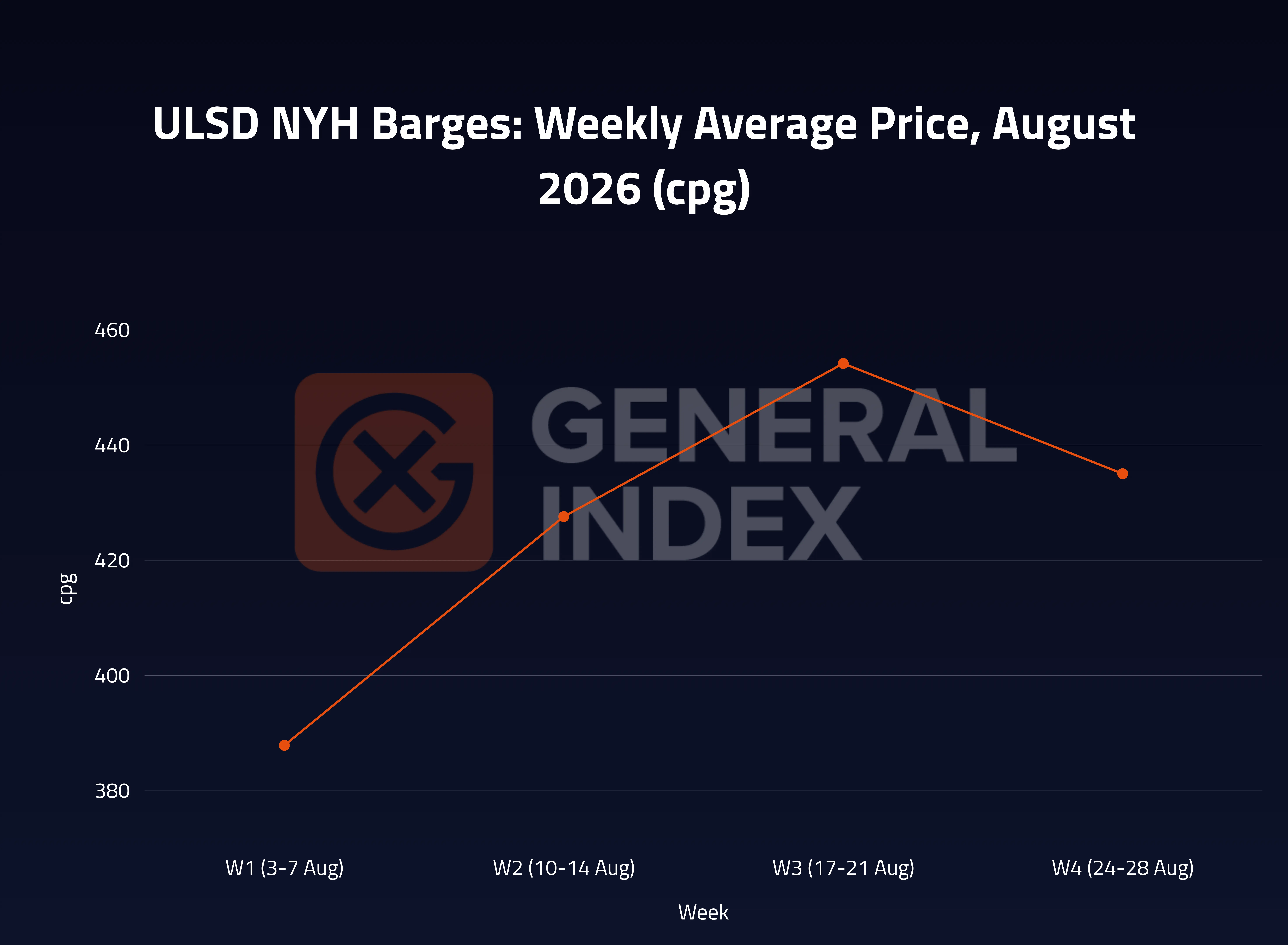
- W3 was the sell-off week at -10.5% WoW as the 17 April Hormuz reopening claim failed to translate to actual transit; W5recovered +8.4% as supply tightness reasserted and the market re-priced the disruption as sustained.
.png)
Cross-Market Dynamics
- Cracks computed against DatedBrent (GX0000968) at 7.45 bbl/mt; Brent rallied from March avg $103.69/bbl to peak $144.46/bbl on 7-Apr, mirroring the product-complex spike-and-crash pattern.
- ULSD 10ppm NWEBarges crack avg $50.66/bbl (Apr) vs $61.21/bbl (Mar), -$10.55/bbl; Gasoil 0.1%NWE CIF crack $46.21 vs $53.31, -$7.10 — heating compressed less because the diesel/gasoil shortfall was concentrated in road diesel.
- Jet Fuel NWE CIF crack collapsed $104.62 →$88.31/bbl, -$16.31 — biggest crack compression in the barrel as flight cancellations across MEG, Asia and Europe destroyed jet demand [IEA OMR, April2026].
- Cracks compressing on rising flat price means refiners gained absolute margin but lost margin-per-barrel; ARA refiners ran hard to capture this, drawing stocks 11% in two weeks to an 8-month low rather than waiting for resupply [Insights Global, via Argus 24 April 2026].
Cross-Regional Dynamics
- ULSD MED CIF avg $1,321/mt vs NWECIF $1,300/mt — MED at $21/mt premium, widening through the month; MED diff vsLSGO went from +$62 (Mar) to +$74 (Apr) while NWE CIF diff narrowed +$78 → +$53— Mediterranean buyers absorbed the brunt of post-Hormuz supply competition.
- Gasoil 0.1% MED CIF diff flipped from -$11.45(Mar) to +$18.95 (Apr) — heating gasoil MED moved from discount to outright premium vs LSGO, the cleanest signal that MED replacement-barrel demand is the regional pinch point.
- Singapore Gasoil 10ppm crashed $241.70 →$171.02/bbl (-29%) intra-month; Asia took the initial Hormuz hit hardest (75%of MEG exports normally East), with Asian middle distillates having peaked above $290/bbl pre-ceasefire [IEA OMR, April 2026].
- East-West gasoil spread compressed from ~$62/bbl(1-Apr) to ~-$5/bbl (29-Apr); the arb that drew cargoes East was largely closed by month-end, removing one structural pull on European supply but signallingAsian repricing is not done.
Curve Structure
- Front collapse on the ICE LSGO curve (GX0000300): M1 fell -$54.25 (-4.0%) over April but every other tenor rallied — M2 +2.3%, M3 +8.1%, M6 +11.9%, M12 +8.5%, M24 +7.4%; prompt sold off as ceasefire-driven length got monetised while M3-M12 priced the disruption persisting beyond two weeks.
- M1-M2 hit peak backwardation $168.75/mt on 9 April (front not yet fully repriced post-ceasefire) before troughing $59/mt on 17 April when the realisation hit that Hormuz flows would not resume; closed+$69.50/mt.
- Daily Structure stayed in backwardation throughout April across all six markets (zero contango days): structure narrowed from -$4.50 to -$3.30/mt avg but never flipped; MED markets showed deepest backwardation (ULSD MED -$4.46, Gasoil 0.1% MED -$4.22), confirming regional outperformance.
- Implication: with the front collapsing while the back rallied, storage carry economics improved but the absolute backwardation level remains near multi-year highs; long deferred vs short prompt is no longer the layup it was in March.
.png)
Price Volatility
- Pre-war regime (Nov-25 to Feb-26): tight 4-5% CV range; March exploded to 11-14% as the war broke out late February; April moderated marginally but stayed in the new regime.
- ULSD 10ppm NWE CIF CV: 9.93% (Apr) vs 13.77% ( Mar) vs 3.94% (Feb) — still ~2.5x pre-war; ULSD Barges 9.98%, Gasoil 50ppm10.37% — entire road-diesel complex above 9.9%.
- Gasoil 0.1% CVs barely moderated (11.34/11.17%Apr vs 11.48/11.45% Mar) — heating volatility regime fully entrenched, with heating grades showing less compression than ULSD because the heating physical pinch persisted longer.
- Hedging models calibrated to pre-war 4-5% range underestimate current risk by ~2.5x; until Hormuz normalises and inventory rebuilds, elevated CV (9-11%) is the baseline assumption for position sizing across the complex.
.png)
Something to Watch
- Hormuz transit volume as the binary catalyst: transit at ~5% of pre-war average (~10-15 vessels/day vs100-120 pre-war) [CNN, 29 April 2026]; ~2,000 tankers stranded in the Gulf [Al Jazeera, 28 April 2026]. Sustained step-up >50 vessels/day triggers a further -10 to -20% flat-price retracement and M2-M6 compression; sustained closure past mid-May triggers further back-curve repricing. Monitor: dailyLloyd’s List/Kpler vessel transit count; insurance war-risk premium rate.
- ARA stocks as the inventory canary: ARAdiesel/gasoil at 8-month low, -11% in two weeks to mid-April [Insights Global, via Argus 24 April 2026]; EU+UK diesel/gasoil arrivals at 695,000 b/d, lowest on Vortexa/Kpler records. A further -10-15% draw in May before flows resume re-intensifies the prompt squeeze and pushes M1-M2 back toward $150/mt; stabilisation accelerates the front-collapse pattern and storage carry returns. Monitor: weekly Insights Global ARA release; weekly EU+UK diesel arrivals via Vortexa/Kpler.
- Watch the cross-grade rotation: if Gasoil 0.1%CVs continue to outpace ULSD CVs into May, the heating-grade pinch is structural and the MED premium will sustain.
- MED-NWE spread as the regional flow indicator: ULSD MED CIF at $21/mt premium over NWE CIF; MED diff vs LSGO at $74/bbl, the highest in the GX series. Sustained MED premium signals Mediterranean buyers still bidding for replacement barrels because Suez/Red Sea flows haven’t normalised; compression signals replacement diesel finding alternative routing.Monitor: weekly MED-NWE CIF spread; Suez Canal eastbound diesel transit.
Note: All figures, prices and market activity referenced in this report are based on the period 1 to 29 April 2026.
.webp)

.webp)