Episode #01 of the knowledge
Two leaders. One cab ride. Fifteen minutes. Last week, we were excited to launch The Knowledge, an interview series filmed in the back of a London taxi, hosted by GX CEO Neil Bradford. For the very first episode, we were excited to get to talk to Daniel Lopez Mateos. David is the founder and CTO of Compute Desk, a London-based price reporting company that publishes daily GPU-hour indexes. Neil and David got a 15 minute cab together from the GX office in Shaftesbury Avenue, down towards Westminster.
Our key takeaways
1) Compute is already a commodity. What it lacks is a mature market
David puts compute trading at around $1tn a year, already roughly a third to half the size of oil trading. The surprising thing is that the physical market has reached that scale before the financial infrastructure around it has really developed. There isn’t yet a liquid futures market giving you a forward curve or an obvious market price to fall back on. That makes pricing compute harder – but also makes a credible index unusually valuable.
2) The index isn't just measuring a market... it's helping to make the market possible.
The scale of the market and the lack of clear data draws the value of good indexes and consistent methodology into clear relief. Benchmarks give the market something to price against, settle against and ultimately build financial products around. Compute Desk and General Index are helping to make this market possible.
3) Compute is technologically novel, but the market dynamics are familiar.
Different GPUs, network configurations and clusters make compute messy to compare, but crude has grades, power has locations and delivery periods, and plenty of other commodity markets started out highly bilateral and fragmented. The most unusual thing about this market is the speed at which it is being built.
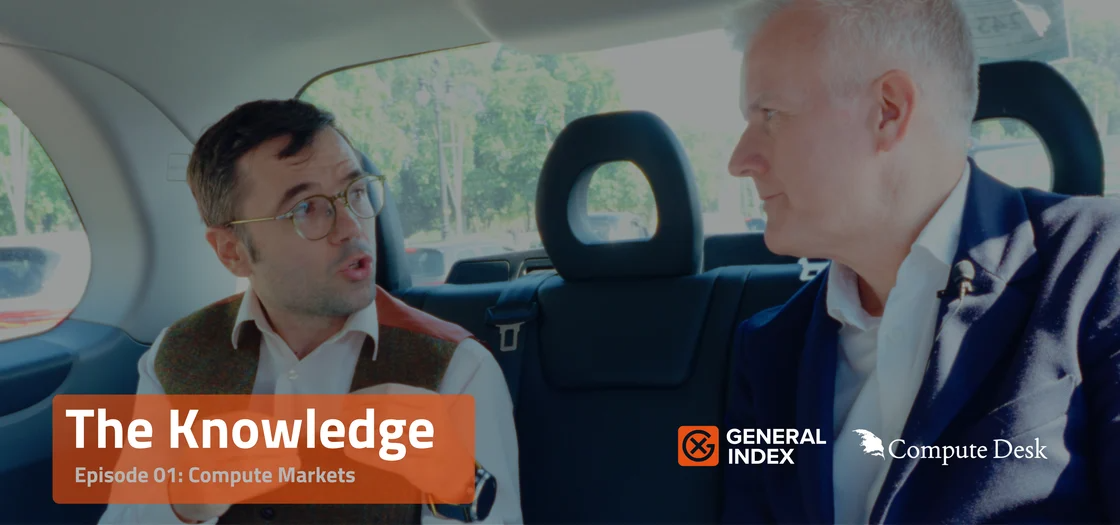
The full interview: inside the $1 Trillion Market for GPU Hours
What is compute?
Neil: We see the headlines in the FT. Our company gets an AWS invoice every month and it keeps going up. Other than that — what is this thing? What is compute?
David: "Compute is the work that is done by a chip. The work is measured in the time that you use that chip. So in that sense it is a little bit like electricity — how long do you use the electricity, kilowatt hour."
"Today, when we refer to compute, people are interested in the compute whose output is intelligence, artificial intelligence. And that's mostly GPUs. So to go from that very basic definition of what compute is, to a GPU hour — that's what people typically refer to as compute."
The unit matters more than it first appears. A GPU hour is a time-denominated unit of work, which is precisely what makes compute tradeable in the way electricity and other commodities are tradeable. You are not buying the asset; you are buying its output over a defined window.
How big is the compute market?
Neil: AI is causing a massive expansion in demand for compute. How is the market evolving?
David: "Something that people don't realise is that the markets are massive. They are already massive. When people talk about it being the new oil, they probably refer to the fact that we estimate that people are trading — that is, buying and selling hours on a GPU — at the scale of about a trillion dollars a year."
"And that's not very far from the scale of oil markets, which are around two to three trillion dollars a year. So this is already happening. A lot of it is obviously being bought by the hyperscalers, but there's a huge amount that is being bought by other companies."
The distinction that follows is the crux of the whole episode:
"They already exist in the physical sense. People are buying compute, they are selling compute. In the financial sense, those financial markets do not exist. There are not very many derivatives being traded, and when they are, they're being traded over the counter, OTC, in bilateral deals that people are doing because they want to hedge their exposure — effectively transfer your risk."
"So what our company is doing is building the infrastructure so that that's possible at a bigger scale. In a market of this size, you want the capital to be efficiently allocated. You want the people who can take the risk to be taking the risk."
Why is compute still a Wild West?
Neil: You've written that this is a nascent market — a wild west. The standards aren't there, the data isn't there. How does it look today, and how does it change over the next five years?
David: "In any market where you're trading an asset, if you want to trade that asset massively and without bilateral deals, you need some level of standardisation. And there is some level of standardisation. An H100 is not sold for the same price as an H200."
"But there is a lot more that goes into that standardisation — whether that's the connectivity between the GPUs, the network access. When people trade, they don't really trade a GPU, they trade a cluster. So there are a lot of dimensions across that cluster that need to be taken into account, and that creates difficulties in developing this market."
This is the part we would underline for anyone coming to compute from another commodity. The problem is familiar:
"That's not different from the idiosyncrasies of other commodity markets, where there was also a problem of standardisation which was solved over time. Part of the work that we do is trying to help with that standardisation, help price the differentials with what a standard might be."
"It is a nascent market, but it's a market that needs to function — and that is already functioning."
What does Compute Desk price?
Neil: What are the units? What are the prices? What is Compute Desk producing and pricing?
David: "We produce indices — or indexes, I guess, depending on which side of the ocean you are on. Obviously that's where the collaboration with you guys has been extremely helpful. What those indexes help you do is understand what the market price is."
"We produce indexes that are at the level of the individual GPU types. An H100, an H200, a B200, a B300. We also internally produce a lot of derivatives from this."
The forward curve is where it gets interesting, because the market cannot yet tell you what it is:
"We have a lot of data that we use for producing these indexes, and that data can be used for understanding what the forward curve might be — which is still not knowable from the market, because futures contracts are still not there. And even once they're there, you will need to have them trading at high enough volume to trust the market on its understanding of the forward curve."
"So there are lots of ways in which we use data to produce insights for people trading GPU hours every day, and the success of their businesses and their financing depends on that understanding."
How are GPU compute prices made?
Neil: In a nascent market you'll see bilateral deals, you'll see posted prices, and there can be massive variances. So what are the data sources? How much trading is actually happening? How do you arrive at a robust data set?
David: "That's the hundred million dollar question. We are very proud of the work that we've done. The quants that work with us have a lot of experience in trading contexts with hedge funds. Myself, I was at a hedge fund for a few years trading precisely commodities."
"We are very proud of how serious we've been about methodology, and part of that also was engaging in a partnership with experts like you guys very early on, so that our indexes could be IOSCO and BMR compliant."
On the inputs themselves, the hierarchy is clear — transacted data first:
"The data sources that we favour are transacted data sources. So these are brokers, big brokers of compute. They are seeing deals every day and want to participate in this market, and they give us their data in an anonymised way so that we can build these indices."
"That's not the only data source that we use. We also have a very comprehensive and very long data set that tells us about the listed prices. And you have to be a little bit careful with those, because some of those listed prices you can believe more than others — but they do give you a sense of where some of the market is sitting. So we combine both of those data sources in a way that adds robustness to the indices."
That last point is worth sitting with. Listed prices are abundant and transacted prices are scarce, which is exactly the temptation a young market has to resist. Weighting them correctly is the methodology.
What is the Nodal Exchange partnership?
Neil: You've just announced a partnership with Nodal Exchange. What are you doing with them?
David: "When you have an index, really what you want is for it to be used for the trading of financial products. Nodal has the biggest contracts for power in the US. They're also owned by the European Energy Exchange, which is very big in power in Europe and in Japan."
"So our partnership with them is to license our indexes for settling futures contracts. They are going to start allowing people to trade on this standardised contract for buying and selling futures. And what our index says the value of the price is, is what's going to be used to settle the contract."
"That enables people buying or selling compute to hedge that exposure, and to fix their price six months from now or a year from now."
The choice of venue is not incidental. Power exchanges already know how to list contracts on a commodity that cannot be stored, is delivered over a period, and varies by location — which describes compute rather well.
What is the biggest challenge in building a compute market?
Neil: What's been the biggest challenge in getting this far?
David: "The biggest challenge is also the most exciting thing, which I would say is that it's a moving target. Things are moving very fast. There is a huge amount of demand."
"But we have to remember that commodity markets in other asset classes and commodities were built over a period of twenty, thirty years — and we are trying to accelerate that, to build them over a period of two and three years. It's a hard thing to do."
"There are lots of functions of the markets that do not exist, and you need to create them, or try to facilitate or partner with people to create them."
That compression is the defining feature of compute as a market story. Crude took decades to move from bilateral contracts to benchmark-settled futures. Compute is attempting the same arc inside a single hardware cycle, while the underlying asset itself keeps changing generation.
What should compute traders understand about financial markets?
Neil: What's the one thing you understand about markets that you wish was more broadly understood — by people who don't necessarily come from financial markets, but who are trading compute?
David: "Financial markets are there as a risk-transferring mechanism, and that's important to you if you're buying or selling compute."
"You might be very good at running a data centre, but maybe you don't want to take certain risks on the price of the GPUs. So you may want to focus on what you're good at. Financial markets are there for you, if that's what you want to do."
For operators and neoclouds in particular, this is the practical takeaway. Price risk on GPU hours is not a cost of doing business that has to be absorbed. It is a position — and like any position, it can be kept deliberately or passed to someone better placed to hold it.
Optimist or pessimist?
Neil: You've been studying these markets for a long time. What's your view — optimism, pessimism?
David: "I'm an optimist. You cannot be an entrepreneur if you're not an optimist."
"It enables people to be smarter. It enables people to operate faster and do things that we all want done faster, and we should embrace it. And the sooner we embrace it, the sooner we'll know where the dangers are and how to limit them."
That is a reasonable note to end on, and not only about AI. A market becomes safe by being used, measured and understood — not by being deferred. The compute market is being built in public, at speed, on data that did not exist two years ago. Getting the benchmarks right now is what determines whether the next trillion dollars of trading happens on solid ground.
%20(1).webp)


.webp)
.webp)
.webp)